Chapter 10: Jobs-to-be-Done Growth "Strategy" Matrix
Introduction to Ulwick's Strategic Matrix
Tony Ulwick's Jobs-to-Be-Done Growth Strategy Matrix offers an approach to needs strategy. Built on 25 years of research across hundreds of markets with Fortune 500 companies, this framework addresses a challenge that most businesses face when planning their next move [42].
As Ulwick observes, "new products and services win in the marketplace if they help customers get a job done better and/or more cheaply" [42]. This explains why some products succeed while others fail, and more importantly, how to predict which strategy will work in a given market situation.
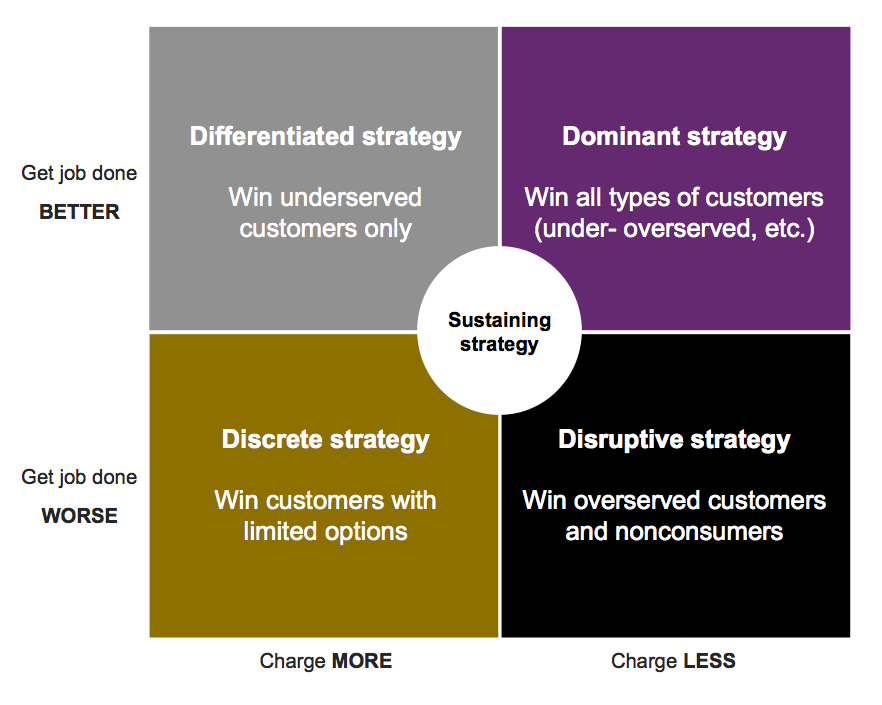
This chapter will go through the 5 different strategies Strategyn promotes based on their ODI approach.
Keep in mind that much of this perspective on strategy is based on the opportunity landscape and where outcomes/needs fall. For example if they are over served, underserved, appropriately served, etc. Given the critiques we have outlined in chapters 7 and 8, this chapter will focus on the theoretical approach of Strategyn's needs based strategy.
The Five Growth Strategies Defined
Differentiated Strategy
A differentiated strategy targets underserved customers who have unmet needs and are willing to pay more for better performance. These customers value getting the job done better over cost considerations.
The strategy works when you can identify a segment that finds existing solutions inadequate. Tesla's early electric vehicles are a clear example. While traditional automakers focused on fuel efficiency improvements, Tesla recognized that environmentally conscious car buyers wanted zero emissions without sacrificing performance. They were willing to pay premium prices for a car that delivered superior acceleration, advanced technology, and environmental benefits.
Similarly, Peloton identified fitness enthusiasts who wanted the energy of group classes combined with the convenience of home workouts. Traditional home exercise equipment felt boring and isolated, while gym memberships required travel time and schedule coordination. Peloton's premium-priced solution delivered the best of both worlds for customers who valued this specific combination highly enough to justify the cost.
Dominant Strategy
The dominant strategy represents the ideal scenario: targeting all customers with a solution that performs much better while costing much less. This approach appeals to most segments because it delivers superior value across both dimensions.
Amazon Web Services changed business computing by offering better reliability, scalability, and functionality than traditional IT infrastructure while cutting costs. Companies no longer needed massive upfront investments in servers and data centers. They could access enterprise-grade computing resources on demand at a fraction of the traditional cost.
Spotify achieved similar dominance in music consumption. Compared to buying individual albums or songs, Spotify offered access to millions of tracks for less than the cost of a single CD per month. The service was more convenient, more comprehensive, and more affordable than existing alternatives, making it attractive to virtually every music listener.
Disruptive Strategy
A disruptive strategy targets overserved customers or nonconsumers with a solution that costs less but performs worse than existing alternatives.
Southwest Airlines built an entire business model around this concept. While major airlines competed on amenities, meal service, and seat comfort, Southwest recognized that many travelers simply wanted reliable, affordable transportation. They removed extras that many customers didn't value, focusing instead on frequent flights, low prices, and dependable service.
Zoom's rise during the early days of video conferencing follows a similar pattern. Enterprise video solutions from companies like Cisco offered extensive features and enterprise-grade security but required technical expertise and investment. Zoom provided adequate video quality with a far simpler setup, making video calls accessible to millions of users who had been priced out of the market.
Discrete Strategy
The discrete strategy operates in situations where customers have limited alternatives due to legal, physical, emotional, or other restrictions. These constrained environments allow companies to charge higher prices for inferior solutions.
Movie theater concessions represent the classic example. Customers pay premium prices for average-quality snacks because theaters prohibit outside food and beverages. The captive audience situation enables pricing that would be impossible in competitive environments.
Wedding vendors often employ discrete strategies as well. Couples planning weddings face emotional and social pressure to create perfect experiences, making them less price-sensitive and more willing to accept premium pricing for services that might cost less in other contexts. The unique, high-stakes nature of weddings creates emotional restrictions that vendors can leverage.
Sustaining Strategy
A sustaining strategy involves incremental improvements that make products slightly better or slightly cheaper. While these improvements may help retain existing customers, they rarely attract new ones or create competitive advantages.
Annual smartphone releases typically follow sustaining strategies. Each new model offers marginally better cameras, slightly faster processors, or modest design improvements. These changes help manufacturers maintain customer loyalty and justify regular upgrade cycles, but they rarely create breakthrough growth or attract customers from competing platforms.
Most software updates fall into this category as well. Adding new features, improving user interfaces, or enhancing performance helps retain existing customers but doesn't fundamentally change competitive dynamics or create new market opportunities.
Determining the right "strategy" based on the opportunity landscape
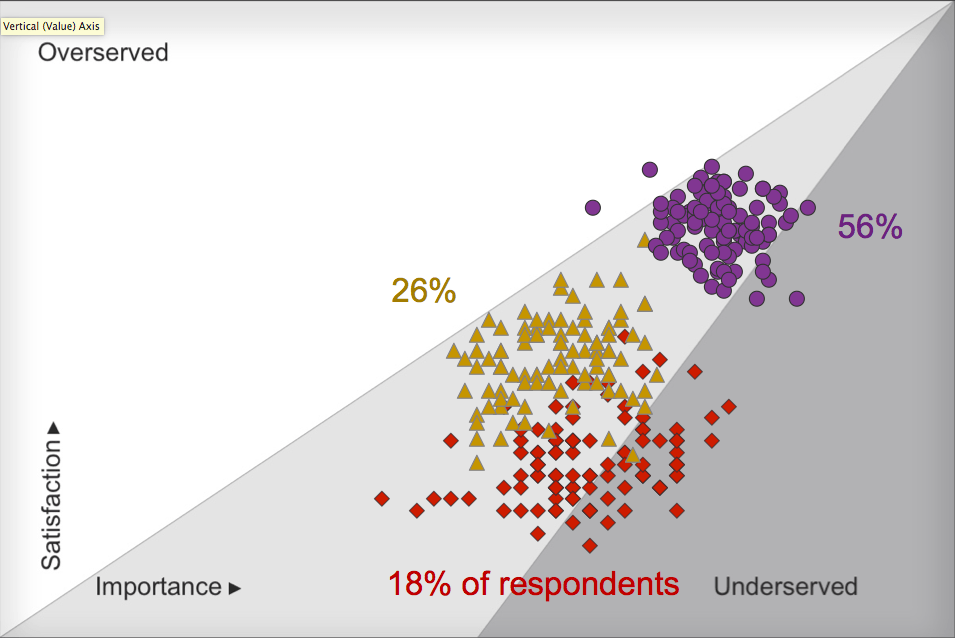
Looking at this satisfaction-importance landscape, we can map where each strategic approach finds its optimal target customers.
Disruptive strategies work best in the bottom right quadrant, where customer needs are highly important but current satisfaction levels are low. This "underserved" territory represents the 18% of respondents who need better solutions but aren't getting them from existing offerings. These customers become prime targets for disruptive innovations that may sacrifice some advanced features in exchange for much better accessibility, affordability, or simplicity in addressing their core unmet needs.
Sustaining strategies operate most effectively in the middle diagonal band, where satisfaction roughly aligns with importance. Here, customers are reasonably well-served by existing solutions, creating opportunities for incremental improvements that enhance performance or reduce costs without fundamentally changing the value proposition. The 26% of customers in this zone typically respond to incremental rather than breakthrough changes.
Overserved customers cluster in the top left quadrant, where satisfaction exceeds importance. This represents the 56% of respondents who are getting more than they actually need or value from current solutions. These customers are open to disruption from competitors who can strip away excess features and complexity while focusing on what truly matters to them at a lower price point.
Dominant strategies Dominant strategies sit outside this framework entirely. When a company achieves dominance, they effectively shift the entire satisfaction axis upward while reducing costs, making their solution attractive to customers across all quadrants simultaneously. Amazon Web Services and Spotify succeeded by delivering superior performance at lower costs, appealing to underserved customers who needed better solutions, overserved customers who wanted simpler and cheaper alternatives, and everyone in between.
Differentiated strategies target specific pockets where importance is high but satisfaction varies widely, allowing companies to command premium prices by delivering superior performance on the dimensions that matter most to these particular customer segments. Meanwhile, discrete strategies can operate across various quadrants when external constraints limit customer choice, regardless of the satisfaction-importance relationship.
Limitations and Critiques of the Matrix Approach
While the Jobs-to-Be-Done Growth Strategy Matrix provides a useful starting framework, it oversimplifies the reality of strategic decision-making. Real strategy involves far more complex factors than customer satisfaction and performance trade-offs.
Markets don't operate in neat categories. Customer segments overlap, needs evolve constantly, and competitive dynamics shift unpredictably. Apple simultaneously pursues different strategies across market segments and geographies, while companies like Tesla have evolved from differentiated to dominant positioning as market conditions changed. The framework provides snapshots but misses the dynamic, multi-faceted nature of actual markets.
The AI disruption paradox reveals limitations. AI tools are disrupting industries where customers have highly underserved and potentially over served needs. ChatGPT doesn't write better than professional copywriters, yet it succeeds with disruptive positioning by offering "good enough" solutions at near-zero cost. This happens because AI represents capability substitution rather than enhancement, replacing entire approaches rather than improving existing ones.
Strategy is complex. Successful strategies must account for regulatory environments, organizational capabilities, competitive responses, technology evolution, capital requirements, network effects, and countless other variables. Tesla's success wasn't just about identifying underserved customers - it required breakthrough battery technology, vertical integration, charging infrastructure development, and regulatory navigation.
The framework offers a helpful lens for thinking about customer needs, but treating it as the only view for a "strategy" would be quite concerning. Strategy requires synthesizing complex, interdependent factors that extend far beyond any single matrix can capture.
A final note on Strategy
ODI is an input, not a strategy. In practice, researchers, product managers, and strategists use JTBD and ODI to inform product decisions or de-risk assumptions about customer needs. The framework helps answer questions like "Are customers satisfied with current solutions?" or "What performance gaps exist?" But strategy requires synthesizing these insights with competitive analysis, organizational capabilities, market timing, regulatory environments, capital requirements, and countless other factors.
The real value is in risk reduction. ODI helps teams avoid building products nobody wants by identifying genuine customer needs and satisfaction gaps.
Strategy is fundamentally more complex. Calling customer satisfaction analysis a "strategy" is like calling market research a business plan. Both provide essential inputs, but neither constitutes the full picture.
The framework offers customer insights that should inform strategic thinking, but practitioners should resist the temptation to treat customer satisfaction mapping as strategy itself. Its strength lies in helping teams ask better questions about customer needs, not in providing comprehensive strategic direction.
Chapter Conclusion - The Value of the Matrix
Communicating the Strategic Story: This brings us back to what I said in Chapter 4. We established that JTBD excels at answering high-level questions like "What markets should we enter?" or "How do we redefine our competitive landscape?"
If the Growth Strategy Matrix has limitations, does that negate the strategic value of the methodology?
Not at all. The conflict is not in the data but in how we define "strategy."
Real strategy is a blend of desirability (what customers want), feasibility (what we can build), and viability (what the business can sustain). The critique in this chapter highlights that the Matrix focuses almost exclusively on desirability. It assumes that if you identify the right customer need, the business model will follow. In the messy real world, that is not always true.
However, this does not diminish its value to senior leadership. Directors and executives value research teams conduct because it provides the strategic story. It anchors complex portfolio decisions in customer feedback rather than internal opinion. It allows a leader to say, "We are pivoting to a Differentiated Strategy because the data proves the market is underserved."
Looking Ahead: From Strategy to Execution
Identifying where customers are underserved is only useful if teams can act on it. The output of JTBD research is typically a spreadsheet of prioritized needs or a matrix showing market positions. But product teams need user stories, design briefs, and backlog priorities. This is the Execution Gap.
The next chapter addresses this gap through three principles:
Context shows you how to overlay your needs-based insights onto your organization's existing personas and frameworks rather than replacing them.
Verification demonstrates how to combine your quantitative priorities with behavioral data and qualitative context to build cases that withstand scrutiny.
Execution provides the tactical translation. It converts abstract needs into user stories, success metrics, and definitions of done that teams can build against.
Together, these principles transform ODI from a strategic input into executable product decisions.
Chapter 10 Summary
-
Core Principle: The chapter introduces Tony Ulwick's Jobs-to-Be-Done Growth Strategy Matrix, which posits that products succeed when they help customers get a job done better and/or more cheaply.
-
Five Growth Strategies: The framework outlines five distinct strategies based on how a product performs relative to existing solutions and what it costs:
- Differentiated Strategy: Targets underserved customers by offering a better solution at a higher price (e.g., Tesla's early models, Peloton).
- Dominant Strategy: The ideal scenario, targeting all customers with a solution that is both better and cheaper (e.g., Amazon Web Services, Spotify).
- Disruptive Strategy: Targets overserved customers or non-consumers with a solution that performs worse but is cheaper (e.g., Southwest Airlines, Zoom).
- Discrete Strategy: Targets customers in constrained environments (legal, physical, etc.) by charging a higher price for an inferior solution (e.g., movie theater snacks).
- Sustaining Strategy: Involves making incremental improvements (slightly better or cheaper) to retain existing customers but rarely creates growth (e.g., annual smartphone updates).
-
The Opportunity Landscape: This tool maps customer needs by importance versus satisfaction to identify strategic opportunities:
- Underserved customers (high importance, low satisfaction) are prime targets for differentiated strategies.
- Overserved customers (low importance, high satisfaction) are vulnerable to disruptive strategies.
- Appropriately served customers are targets for sustaining strategies.
-
Limitations and Critiques: The matrix is a useful starting point but has limitations:
- It oversimplifies real-world markets, which are dynamic and complex, not neat categories.
- It fails to adequately explain modern disruptions like AI, which substitute capabilities rather than just competing on performance and cost.
- Real strategy must account for numerous other factors beyond this matrix, including regulations, technology, organizational capabilities, and competitive responses.
Chapter References
[42] Ulwick, Tony. “The Jobs-to-be-Done Growth Strategy Matrix.” Jobs-to-be-Done.com, 6 Jan. 2017. Available at: https://jobs-to-be-done.com/the-jobs-to-be-done-growth-strategy-matrix-426e3d5ff86e
[43] Ulwick, Tony. “The Job-to-Be-Done Growth Strategy Framework.” Strategyn.com. Available at: https://strategyn.com/5-business-growth-strategies-jobs-to-be-done/