Chapter 5: The Job Map
The solution agnostic journey for your core functional job
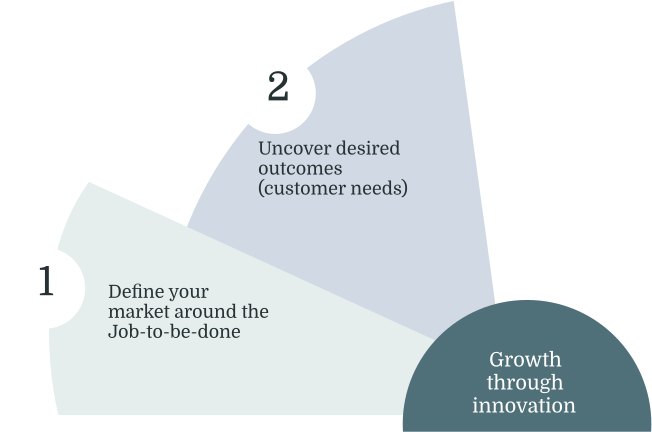
With the core job defined, the next step is deconstructing it. The Job Map helps you understand the different steps the main job executor is taking in order to get the job done.
Job Map Introduction
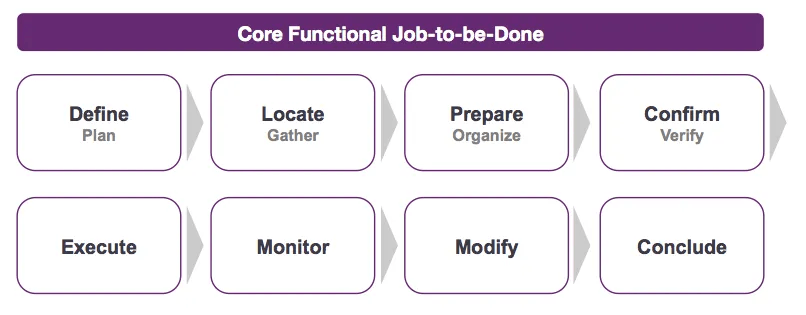
After you have determined the core functional job that will serve as the foundation for your JTBD research, the next part of step two in the ODI process is to build out the job map.
The Job Map breaks the core functional job into a series of solution-agnostic steps that represent the ideal path to success. I like to think of it as a solution agnostic customer journey map. The major difference is that a Customer Journey Map outlines the current process in how customers are currently using your product or service. It outlines transaction moments, pain points within the journey, and what the customer is actively doing.
Job Map Fundamentals
The Job Map differs by focusing more on the goals a user is trying to achieve in order to get their core functional job done. The job map follows a few key principles.
- Generalized – the job steps must be relevant to anyone doing the job.
- Ideal – all job steps must be in the optimal order for execution.
- Functional – all job steps of the core job must be functional, not emotional.
- Format follows the rules for core functional jobs (solution agnostic, format, no jargon, etc.).
- Active – all job steps state what the customer tries to accomplish in each job step.
- Completeness– the job map should cover all steps of the Universal job map; typically 10-20 steps
Tony Ulwick says, "A job map does not show what the customer is doing (a solution view); rather, it describes what the customer is trying to get done (a needs view)".[30]
Job Map vs. Customer Journey Map
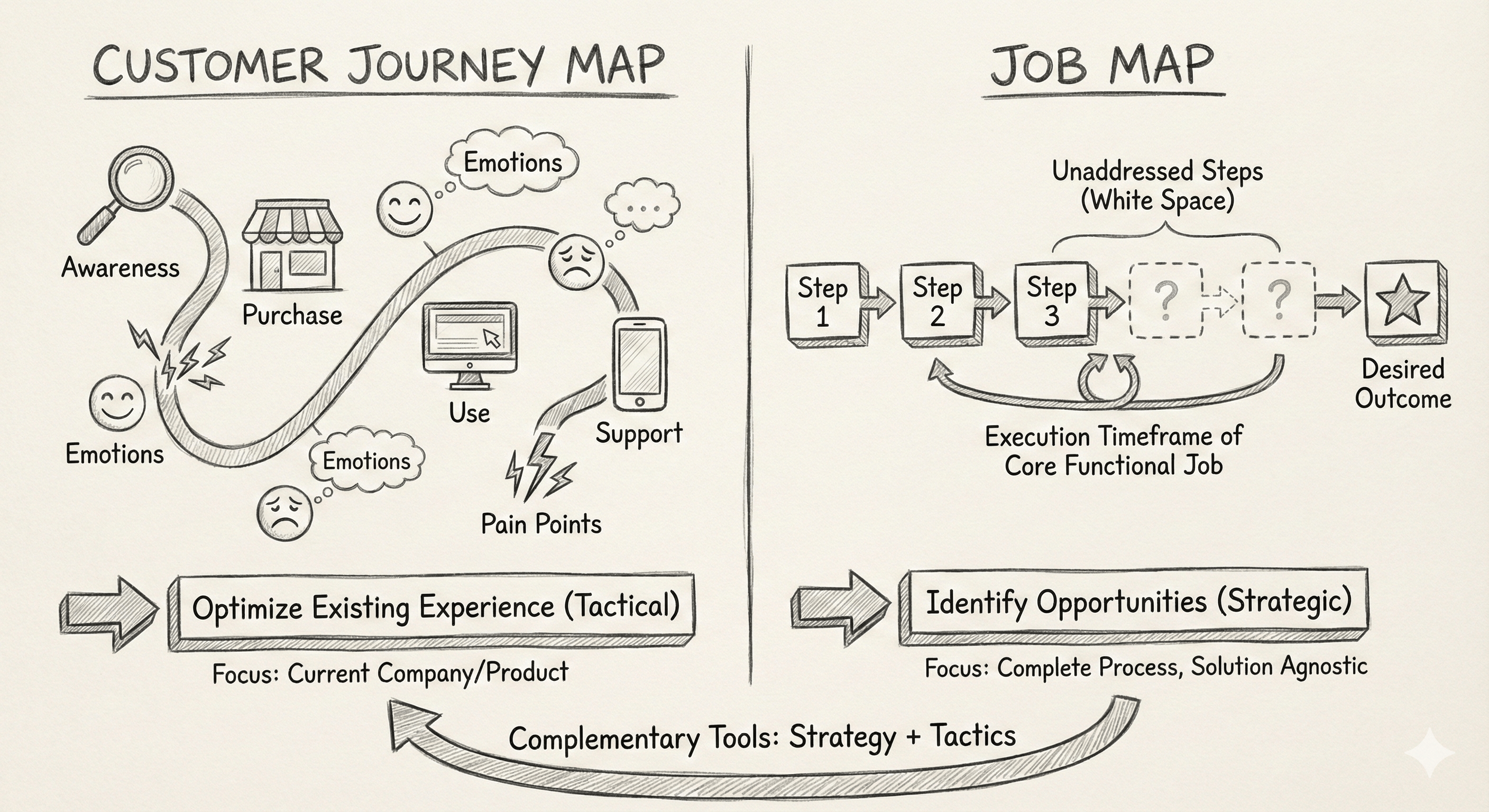
The distinction between Job Maps and customer journey maps reflects a distinct difference in perspective and purpose that impacts focus on product improvements or overall strategy. Customer journey maps typically focus on documenting the current experience customers have with a specific company, product, or service, mapping touch-points, emotions, and pain points within the existing relationship. While valuable for improving current customer experience, this approach limits the scope of insight to incremental improvements within the current solution paradigm.
Job Maps start differently by focusing on the job itself rather than any particular solution. This job-centric perspective reveals the complete process customers need to execute, including steps that current solutions may not address at all or may address poorly. By maintaining solution agnosticism, Job Maps expose white space opportunities and highlight fundamental job steps that competitors may be ignoring or underserving.
The scope also differs notably between these two tools. Customer journey maps typically capture the experience from initial awareness through purchase and ongoing use of a specific solution, reflecting the linear progression through a company's sales and service processes. Job Maps, in contrast, focus on the execution timeframe of the core functional job itself, which may be much shorter or longer than any individual customer journey and may involve multiple solutions or no solutions at all.
This difference in scope and perspective makes Job Maps helpful for identifying a different perspective on opportunities, while customer journey maps excel at optimizing existing customer relationships and experiences. Organizations benefit most from using both tools in complementary ways, with Job Maps informing strategic decisions and customer journey maps guiding tactical experience improvements.
How to Build a Job Map
Step 1: Starting with your Core Functional Job
See Chapter 4, Identifying the Core Job, to help determine what the core functional job of your product or service is. Once you have that, you can start building out your job map.
To provide an example of creating a job map throughout this chapter, we will use the core job, "Communicate information clearly to an audience for understanding."
Step 2: Identifying the Job Steps
The next step is to identify the job steps for a core functional job. It is recommended to follow the generic 8 steps job map template like the above image highlights of the 8 steps for a core functional job.[28]
The 8 steps are listed below, along with questions you can ask participants during interviews:
- Define
- Where/when does the job begin? The job begins when there's a need to share specific information with others for a purpose.
- What must be defined up front? The communication objective, target audience characteristics, key message, desired outcome, and success criteria.
- Locate
- What must be located, gathered or retrieved? Relevant data, supporting evidence, credible sources, audience contact information, appropriate communication channels, and any existing materials or templates.
- Prepare
- What must be organized, examined, or set up? Structure the information logically, choose the right format/medium, prepare visual aids if needed, schedule timing, and set up the delivery environment or platform.
- Confirm
- What must be validated before execution? Verify information accuracy, confirm audience availability, test technical setup, review message clarity, and ensure all materials are ready.
- Execute
- What's at the heart of getting the job done? Deliver the core message using chosen communication method, engage the audience appropriately, and present information in a clear, structured manner.
Authors Note: The Execute step is not the entire job. It is the moment the user engages in the core action. For example, in 'dental surgery,' the job includes preparation and recovery, but the 'Execute' step is the surgery itself.
- Monitor
- What must be monitored during execution? Audience comprehension signals (questions, body language, engagement), technical performance, time management, and message reception.
- Modify
- What adjustments might be needed? Clarify confusing points, adjust pace or complexity, address unexpected questions, resolve technical issues, or adapt to audience feedback in real-time.
- Conclude
- What must be done to successfully conclude? Summarize key points, confirm understanding, provide follow-up resources, establish next steps, and document outcomes or lessons learned.
These are the recommended steps to start with when creating a job map. From here you can branch off into more granular or less granular steps depending on how detailed you want your job map to be.
Ok, let's imagine again we are using the core functional job of Communicating information clearly to an audience for understanding. Let's review the transcript below of asking the questions for each job map step and see how we can construct a job map based on the responses from the participant.
Example Interview
Interviewer: Let's start with the heart of what you're trying to accomplish. When you need to communicate important information to your team, what's the most central task or the core of what you are trying to get done?
Marketing Manager: Well, it's really about delivering the message in a way they can act on it [Execute]. I'm usually presenting findings from our customer research or explaining a new campaign strategy.
Interviewer: Got it. Now let's back up, where does this job actually begin for you? What triggers the need to communicate?
Authors Note: Notice in the interview that we don't start the conversation by asking about the beginning of the job (the Define step). Instead, we start by asking about the Execute step—the heart of the action. It is often easier for customers to describe the main action first (e.g., 'delivering the presentation'). Once they are grounded in that moment, it becomes easier for them to work backward and answer questions like, 'What did you have to plan or define before you reached that point?
Marketing Manager: It usually starts when I have new insights that will change how the team approaches their work [Define]. Like last week, our user research revealed customers were confused about our pricing tiers.
Interviewer: What do you need to figure out or define before you can move forward?
Marketing Manager: I need to be clear on what action I want them to take afterward [Define]. Am I asking them to change existing campaigns? Create new materials? Just be aware for future work? That shapes everything else.
Interviewer: That's the "Define" step emerging. What do you need to gather or locate to make this work?
Marketing Manager: I pull together the actual research data, maybe some customer quotes, competitive examples [Locate]. I also need to check everyone's calendars [Locate] and figure out if this needs to be email, Slack, or a proper meeting.
Interviewer: Before you actually deliver the information, what do you need to prepare or set up?
Marketing Manager: I usually create an outline or slides if it's complex [Prepare]. For the pricing thing, I made a simple visual showing the customer confusion points. I also book a conference room [Prepare] and make sure the projector works - learned that the hard way!
Interviewer: What do you double-check or confirm before you actually start communicating?
Marketing Manager: I rehearse key points to myself [Confirm], especially if there might be pushback. I also verify my facts [Confirm] - nothing kills credibility like getting basic numbers wrong.
Interviewer: During the actual communication, what are you monitoring or watching for?
Marketing Manager: Facial expressions are huge [Monitor] - I can see when people are confused or skeptical. I watch for when people start checking phones [Monitor] - that means I'm losing them. I also listen for the types of questions [Monitor] they ask.
Interviewer: When do you need to modify or adjust your approach?
Marketing Manager: If I see confusion, I slow down and give more examples [Modify]. If they seem skeptical, I pull out additional data [Modify] or ask them to share their concerns. Sometimes I realize mid-presentation that I should have started with the business impact [Modify] rather than the research details.
Interviewer: How do you know when the job is successfully completed?
Marketing Manager: When people start talking about next steps without me prompting them [Conclude]. Like, "So should we pause the current email campaign?" or "I can update those landing pages by Friday." That tells me they understood and are ready to act.
Interviewer: What do you do to wrap things up?
Marketing Manager: I always send a follow-up email with the key points and any agreed actions [Conclude]. I also set calendar reminders to check in [Conclude] on whether changes actually happened.
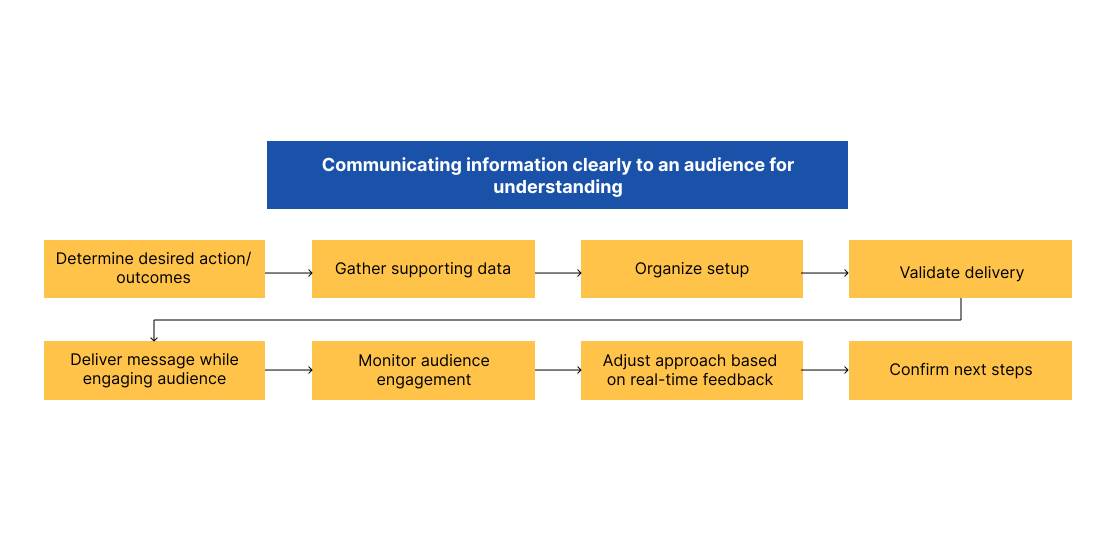
Key Job Steps Revealed:
- Define: Determine desired action/outcome
- Locate: Gather supporting data
- Prepare: Organize setup
- Confirm: Validate delivery
- Execute: Deliver message while engaging audience
- Monitor: Monitor audience engagement
- Modify: Adjust approach based on real-time feedback
- Conclude: Confirm next steps
Notice how the generic 8-step template guided the questioning, but the job steps emerged naturally from the conversation rather than being imposed.
The 8 Steps Are Your Starting Point, Not Your Limit
The 8 generic steps serve as guardrails, not rigid requirements. Depending on your core job's complexity, you might end up with 8 - 15 steps. A simple consumer task might compress into fewer steps, while complex B2B processes or manufacturing operations often require 12-15 detailed steps to capture the full reality.
Use the 8 steps as a starting point to ensure you don't miss major phases, then expand where your customer interviews reveal additional complexity.
Taking Your Interview Insights and Creating Order
Let's return to our communication example and expand it beyond the basic 8 steps. After conducting several interviews, you might have gathered insights like:
- I need to know what action I want them to take
- I have to figure out if this is urgent or can wait
- I check everyone's calendars
- I need to gather the right supporting evidence
- I create different materials for different audiences
- I rehearse key points to myself
- I watch facial expressions during the presentation
- I adjust my approach if people seem confused
- I send a follow-up email afterward
- I check back later to see if action was actually taken
Your first task is to map these insights using the 8 core steps as your foundation, then expand where the complexity demands it:
Define Phase:
- Assess Urgency → Determine timing and priority level
- Define Outcome → Clarify desired action and success criteria
- Identify Audience → Understand who needs this information
Locate Phase:
- Gather Evidence → Collect supporting data and examples
- Check Availability → Confirm audience schedules and accessibility
- Select Channels → Choose appropriate communication methods
Prepare Phase:
- Create Materials → Develop audience-appropriate content
- Setup Environment → Book space and test technology
Confirm Phase:
- Validate Content → Verify facts and rehearse delivery
Execute Phase:
- Deliver Message → Present information while engaging audience
Monitor Phase:
- Track Reception → Watch for comprehension and engagement signals
Modify Phase:
- Adjust Approach → Adapt based on real-time feedback
Conclude Phase:
- Secure Commitment → Confirm understanding and next steps
- Follow Up → Check that promised actions actually occur
Ensuring Complete Coverage
Look for gaps in your expanded framework. If you have detailed steps for preparation but nothing about follow-up, go back to your interviewees and ask: "After the communication is over, what do you do to ensure it was successful?"
Watch for phases that seem too sparse. Complex jobs often have multiple sub-steps within each major phase. A manufacturing process might have 3-4 steps just within the "Confirm" phase.
Sequencing the Steps Properly
While the 8 generic steps provide a natural flow, pay attention to the actual sequence your customers follow. Sometimes they'll say things like:
"Actually, I usually start gathering data before I'm even clear on what I want to accomplish."
This suggests their job might actually start with "Gather Evidence" activities that help them "Define Outcome." Don't force their reality into the template—adapt the template to reflect how the job really gets done.
Creating a Usable Format
Transform your organized insights into a clear job map format:
Job: Communicate information clearly to an audience for understanding
- Assess Urgency → Determine timing and priority level
- Define Outcome → Clarify desired action and success criteria
- Identify Audience → Understand who needs this information
- Gather Evidence → Collect supporting data and examples
- Check Availability → Confirm audience schedules and accessibility
- Select Channels → Choose appropriate communication methods
- Create Materials → Develop audience-appropriate content
- Setup Environment → Book space and test technology
- Validate Content → Verify facts and rehearse delivery
- Deliver Message → Present information while engaging audience
- Track Reception → Watch for comprehension and engagement signals
- Adjust Approach → Adapt based on real-time feedback
- Secure Commitment → Confirm understanding and next steps
- Follow Up → Check that promised actions actually occur
Each step should have a clear trigger (what prompts this step) and outcome (what's accomplished when it's complete). This creates a logical flow that others can follow and validate.
Remember: The right number of steps is however many it takes to accurately capture your customers' reality. Simple jobs might compress to 8 steps, complex industrial processes might expand to 18. The 8-step framework ensures you don't miss any major phases along the way.
Identifying the Right Granularity
One of the most common challenges in job mapping is finding the right level of detail. Too granular, and your job map becomes unwieldy and loses strategic value. Too high-level, and you miss opportunities. The key is finding the "Goldilocks zone" where each step reveals actionable insights.
The Granularity Test: Can You Innovate Here?
Ask yourself whether a product, service, or solution could make this step noticeably better, faster, or easier. If the answer is yes, you're at the right level of granularity. If not, you may need to zoom in or zoom out.
"Click the send button" represents too much granularity because this micro-action offers little opportunity for meaningful innovation. "Communicate the message" is too broad because it encompasses too much and obscures pain points. "Deliver message while engaging audience" captures the right level because it represents a meaningful job step with clear opportunities for improvement through presentation tools, engagement techniques, and feedback mechanisms.
Consider Your Scope
The right granularity depends on what you're trying to innovate. If you're building communication software, you might need more granular steps around content creation and delivery. If you're designing organizational processes, you might focus on higher-level coordination steps.
From a software company perspective, you might focus on steps like creating slides, formatting content for mobile, and tracking message opens because you can build better tools for these activities. From an organizational consultant perspective, you might emphasize aligning stakeholders on messages and cascading information through hierarchy because you can improve these processes.
Test with the "So What?" Question
For each step, ask what could go wrong and what would make this noticeability better. If you can't generate compelling answers, the step might be too granular, too broad, or not part of the core job.
Practical Granularity Guidelines
Right-sized steps typically share several characteristics:
- Have a clear beginning and end
- Involve a decision or create an output
- Can fail or succeed independently
- Present opportunities for measurement
- Could benefit from tools, services, or improvements
Warning signs of wrong granularity include steps that are sub-tasks of other steps, steps with no clear success criteria, steps that never fail or cause problems, steps that require no decisions or judgment, and steps that offer no room for innovation.
Remember that you can always adjust granularity later. Start with what feels natural from your interviews, then refine based on where you see the most potential and customer frustration.
Method of Validation
There are several methods for validating your job map, and the approach you choose depends on your familiarity with the core functional job and the domain expertise required.
For jobs you've personally experienced many times, you might feel confident validating your job map with just 2-4 interviews. Take our communication example around presenting information to an audience. If this represents a core job you've executed repeatedly throughout your career, you can often validate the steps based on your own experience combined with minimal external input.
However, when dealing with core jobs that require industry knowledge or domain expertise in fields like manufacturing, medicine, or law, expert feedback becomes essential. These specialized domains have nuances and steps that only subject matter experts (SMEs) would recognize. These might require more than just 2-4 interviews.
The Secondary Research Approach
I always recommend teams conduct secondary research on a core job and create a hypothesized job map before validating with users. If you're working in healthcare and evaluating a core job around using medical devices, start by reading medical reports, research articles, and reviewing transcripts related to that job. This preparation creates a stronger foundation for your validation interviews.
The Validation Interview Process
After developing your hypothesized job map, conduct 3-5 follow-up interviews with the main job executors. Present your job map and ask targeted questions about its accuracy. Are there missing steps they would add? Do they perceive any steps as confusing or unnecessary? Would they sequence anything differently?
These validation interviews serve a dual purpose. Beyond confirming your job map's accuracy, they provide deeper insights into the different outcomes within each job step and the complexity factors that influence execution. See chapter 6 for more details on outcomes and complexity factors This additional layer of understanding matters for identifying the most impactful opportunities.
The goal isn't perfection but confidence that your job map reflects the real experience of people executing this job in the field.
Using the Job Map for competitive positioning
One of my favorite ways to use a job map is to evaluate where your company's portfolio of solutions or a specific solution lies vs. your competitors.
To illustrate this, let's look at a crowded market like the music streaming service market. Companies like Spotify, Apple Music, YouTube Music, Tidal, and many more all exist.
Let's imagine we are part of the consumer strategy group looking at how we could expand the core Spotify solution into other opportunities. To get a sense of where things currently are in the market, let's create the job map for Spotify's core functional job, "Listen to Music".
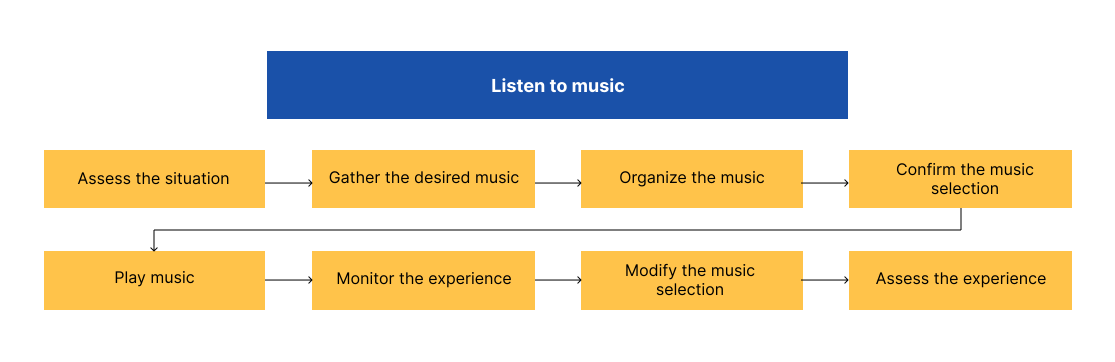
As we can see with the above job map, it's quite clear that Spotify, and really any music streaming service for that matter adequately addresses each job step. This means the current core job offers few opportunities for major improvements.
Like we discussed in chapter 4 about flight levels, let's evaluate what a job map might look like for a higher flight level core job. A trick I like to do for this is to go back and look at the core mission of a company to get a sense of what their ultimate goal is. Let's look at Spotify's mission statement.
Let's try and break this down into a core functional job with a higher flight level than just listening to music.
Looking at Spotify's mission, we need to focus on the consumer side: "billions of fans the opportunity to enjoy and be inspired by it." The key functional elements here are "enjoy" and "be inspired by" creative content.
If we apply our core functional job syntax to this:
- The verb would be "Discover" (since enjoyment and inspiration require finding the right content)
- The object is the creative content itself
- The contextual clarifier captures the purpose: "for personal enjoyment and inspiration"
But notice that Spotify's mission doesn't limit this to music, it also refers to "art" and "creativity" broadly. This suggests their higher-level job isn't just about music discovery, but about connecting people with creative content that can move them emotionally or intellectually.
Given Spotify's expansion into podcasts and audiobooks, we can see they've already recognized this broader opportunity. So our higher flight level core functional job becomes: "Discover audio content for personal enjoyment and inspiration."
This reframing matters because it shifts us from thinking about Spotify as a music company competing with Apple Music and YouTube Music, to thinking about them as an audio content discovery platform competing in a much larger market that includes educational content, storytelling, news, and any other audio that can entertain or inspire people.
Let's visualize now what a job map for this new core functional job might look like.
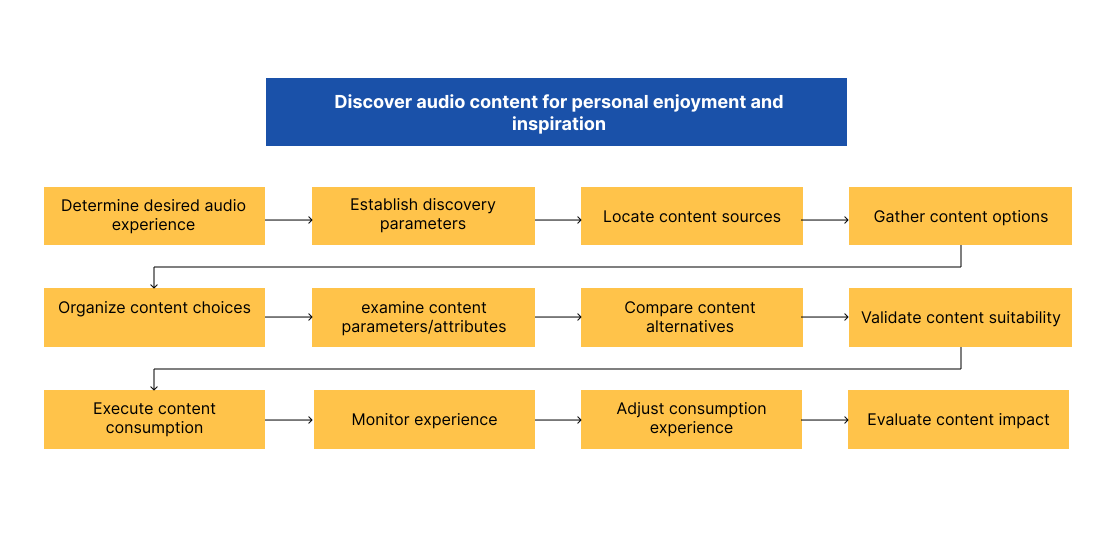
As we can see, some of the job steps are similar to the original job map, but at a higher level of abstraction—audio instead of music. With this in mind, what markets could Spotify evaluate now?
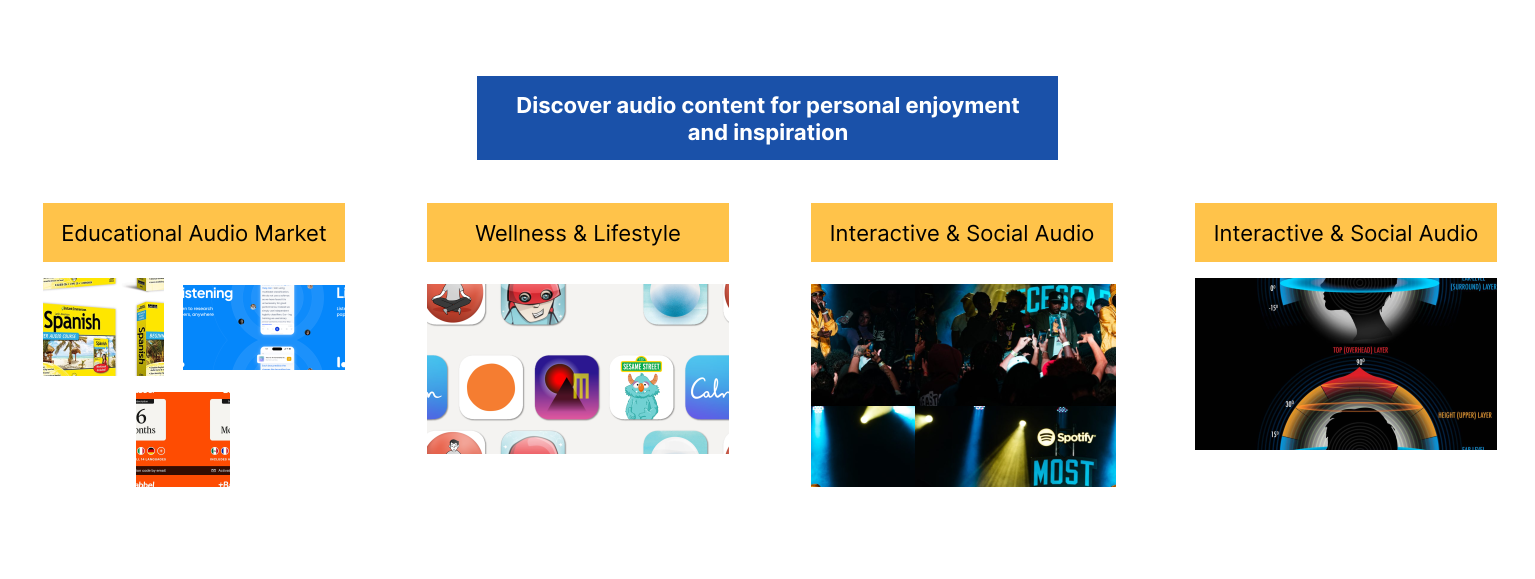
Let's see, they could think about the educational audio market where millions of people are trying to learn new languages through interactive audio courses or develop professional skills through specialized audio programs. University students and lifelong learners represent a massive audience seeking academic lectures and educational content that they can consume while commuting or exercising. The children's market presents another major opportunity with interactive audio stories and educational content that parents are actively seeking for their kids.
The wellness and lifestyle audio space is growing quickly as more people seek guided meditation, sleep content, and fitness coaching. Mental health awareness has created demand for audio content that supports emotional wellbeing and mindfulness practices.
Interactive and social audio represents a growing area where Spotify could facilitate live audio events, create community features around shared listening experiences, and develop immersive audio gaming experiences that go far beyond traditional passive consumption. This could change how people connect through audio content.
Professional markets present opportunities in business-specific audio content, personalized news curation, and productivity tools that help people stay informed and efficient. The rise of remote work has created demand for better audio collaboration tools and meeting enhancement features.
Finally, emerging audio technologies like spatial audio experiences, AI-generated personalized content, and real-time audio translation could position Spotify at the forefront of next-generation audio innovation, creating entirely new categories of audio discovery and consumption.
By viewing these new markets through the job map, Spotify can see that its existing capabilities provide a powerful foundation for expansion.
First, their recommendation and personalization engines are directly transferable. The algorithms that help users "examine content attributes" and "compare alternatives" for music can just as easily be applied to podcasts, audiobooks, or educational lectures. This core competency gives them an immediate competitive advantage in helping users find the right content, regardless of the format.
Second, their proven expertise in content organization and delivery provides a ready-made blueprint for new verticals. The logic used to organize music into playlists can be adapted to structure educational courses by skill level or wellness content by specific need. Likewise, the robust infrastructure built to "execute content consumption"—powering offline listening and cross-device sync—is agnostic to the content itself, whether it's a three-minute song or a ten-hour audiobook.
Finally, and perhaps most significantly, Spotify's behavioral data is its biggest advantage. Their understanding of how users "define discovery intent" reveals patterns about when people seek different types of audio throughout their day, week, or life. This intelligence is useful for entering markets like wellness, where understanding a user's emotional state can make the difference between content that helps and content that gets skipped.
Conclusion
-
A Job Map provides a clear framework for deconstructing a core functional job into its essential, solution agnostic steps.
-
The Job Map's focus on the user's underlying goals, rather than their interaction with a specific product, distinguishes it from a traditional customer journey map.
-
The universal eight step template serves as a starting point for structuring customer interviews and ensuring comprehensive coverage of the job.
-
Effective job mapping requires moving beyond the generic template to add or combine steps that accurately reflect the customer's true process.
-
Determining the correct level of granularity for each step matters for uncovering meaningful and actionable insights.
-
The Job Map is a tool for visualizing competitive positioning and pinpointing weaknesses or gaps in the current market.
-
Elevating the core functional job to a higher flight level can reveal adjacent market opportunities and redefine a company's strategic landscape.
Chapter 5 Exercises
Exercise 1: Map a Personal Job
Choose a common, routine job you perform regularly. Examples include "prepare a meal at home," "do the laundry," or "plan a weekly workout schedule."
- Write down the core functional job using the
[verb] + [object of the verb] + [contextual clarifier]format. - Build a complete job map for this job. Start with the 8 universal steps (Define, Locate, Prepare, Confirm, Execute, Monitor, Modify, Conclude) and then expand it to between 10 and 15 more granular steps that accurately reflect your process.
- Review your final list of steps. Are they truly solution-agnostic? For example, instead of "Look up a recipe on Google," the step should be "Find instructions for preparing the meal."
Exercise 2: Job Map vs. Customer Journey Map
Think about the last time you bought a ticket for an event, like a concert or a movie.
- First, create a Customer Journey Map for that specific experience. Document the actual steps you took, the touchpoints you interacted with (e.g., Ticketmaster website, a specific theater's app), and your feelings at each stage (e.g., frustrated by fees, excited at checkout).
- Next, create a solution-agnostic Job Map for the core functional job: "Secure access to an event."
- In 1-2 sentences, describe the biggest difference between the two maps you created.
Exercise 3: Find the Right Granularity
Below is a list of potential steps for the core job, "Acquire a new professional skill." For each one, determine if its level of detail is Too Broad, Too Granular, or Just Right. Briefly explain your reasoning.
- A. Get educated.
- B. Click the "play" button on a video lesson.
- C. Identify knowledge gaps.
- D. Evaluate potential learning resources.
- E. Type a search query into a search engine.
- F. Apply the learned skill in a practical setting.
Exercise 4: Competitive Analysis with a Job Map
Let's analyze the market for finding a new place to live. The core functional job is "Find a new residence to occupy."
Consider two different solutions that help with this job:
- Solution A (Craigslist): A basic, open-ended classifieds platform where users can post and browse listings.
- Solution B (Zillow): A feature-rich platform with detailed filters, map-based search, saved searches, 3D tours, and agent contact forms.
- Create a comprehensive job map for "Find a new residence to occupy."
- For each step in your map, decide whether Craigslist or Zillow is better suited to help the user get it done. Note which steps are poorly served by both.
- Based on your analysis, where is there an opportunity for a new product or service to innovate in this market?
Chapter 5 References
[28] Ulwick, A. W. (2016). Jobs to Be Done: Theory to Practice. Paperback, October 28, 2016. Retrieved from https://www.amazon.com/Jobs-be-Done-Theory-Practice/dp/B0CCZV8JJH/
[30] Ulwick, Tony. “Mapping the Job-to-be-Done.” Jobs-to-be-Done.com, 12 Jan. 2017. Available at: https://jobs-to-be-done.com/mapping-the-job-to-be-done-45336427b3bc.