Chapter 3: Defining your market around the Job-to-be-Done
Describing your market around the JTBD changes the perspective in who you target

Defining the market around the job-to-be-done is the first step in the ODI process, setting the foundation for all subsequent research efforts.
When using the ODI approach, we use a specific syntax to ensure we are looking at the market correctly:
Market = [Job Executor] + [The Job-to-be-Done]
This implies that a "market" is not defined by a region (e.g., "The US Market") or a technology (e.g., "The SaaS Market"). Instead, a market is simply a group of people trying to get a specific job done.
Defining the market through a JTBD lens
Traditional market definitions often revolve around products or solutions, which limits our understanding of customer needs and opportunities.
Consider the evolution of navigation. If we had defined the market as "paper maps," we would have missed the fundamental job that people were trying to get done: "Determine the most time efficient route for travel." This job has remained constant even as solutions evolved from paper maps to GPS devices to smartphone navigation apps.
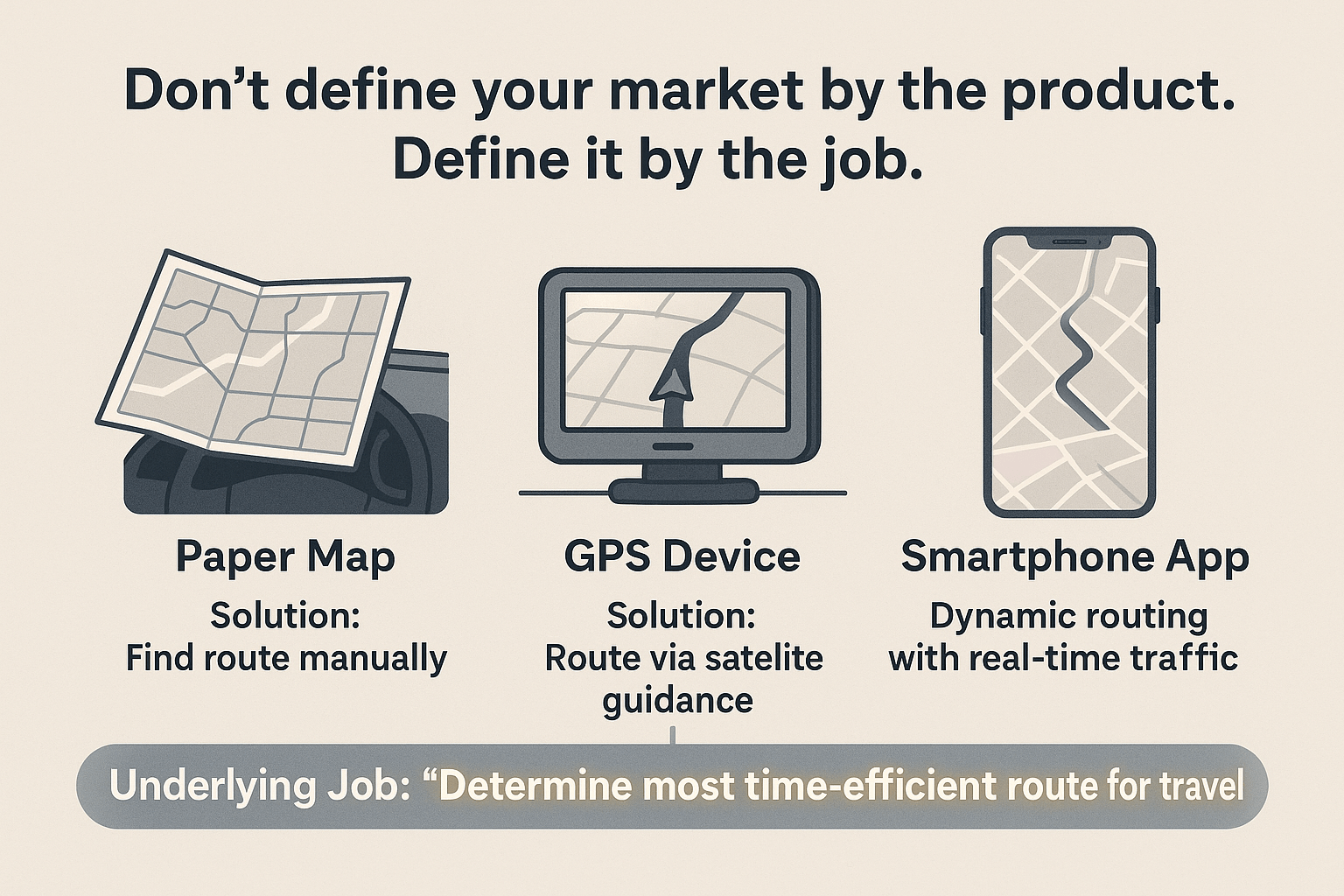
The key to defining markets through a JTBD lens is to shift focus from the solution to the underlying job.
Take the fitness industry as an example. Rather than defining separate markets for treadmills, fitness classes, and personal training, we need to consider the deeper core job that people are truly trying to accomplish. While it might seem like "improve physical fitness" is the job, for many people the true job might be "increase longevity," "feel confident in my appearance," or "maintain independence as I age." This shift in perspective which limits how we view the competitive landscape.
If someone's core job is "increase longevity," then Peloton, local gyms, and fitness apps aren't just competing with each other; they are competing with everything from meditation apps and dietary supplements to sleep tracking devices and preventive healthcare services. Similarly, if the core job is "feel confident in my appearance," the competition extends beyond traditional fitness solutions to include clothing brands, cosmetics, mental health apps, social media filters, and even drugs like GLP-1.

This broader understanding of the core job reveals that companies often define their competition too narrowly. A fitness equipment manufacturer focusing solely on competing with other equipment makers might miss that their real competition includes walking groups, gardening clubs, or even social dancing classes. All of which might serve the customer's true job just as effectively.
The transportation industry offers an illustration of this through Uber's approach. Travis Kalanick and the founding team didn't set out to build a "better taxi company." They focused on the job of "getting from point A to point B reliably and conveniently."[22, 23] This perspective helped them see that their competition included not just taxis, but car ownership, public transportation, and even decisions to stay home. Kalanick often spoke about "transportation as reliable as running water,"[23] demonstrating their understanding of the fundamental job customers were trying to accomplish.
Airbnb similarly demonstrates this job-focused thinking. Brian Chesky has consistently articulated that Airbnb's job isn't about "short-term rentals" but about "belonging anywhere." [24] This job-focused definition led them to compete not just with hotels, but with the entire travel experience, eventually expanding into experiences and long-term stays.
When companies define their markets around jobs rather than products or technologies, they create a stable foundation regardless of how the technology changes.
The Job Executor, Product Support Team, and Purchase Decision Maker
One of the key steps in defining your market is identifying who actually executes the core functional job. While this might seem straightforward, many teams stumble by confusing the job executor with buyers or support personnel. It is vital to understand the distinction between three key roles:
- The Job Executor: The person using the product to get the job done.
- The Product Lifecycle Support Team: The people who install, maintain, or clean the product.
- The Purchase Decision Maker: The person who pays for the product.
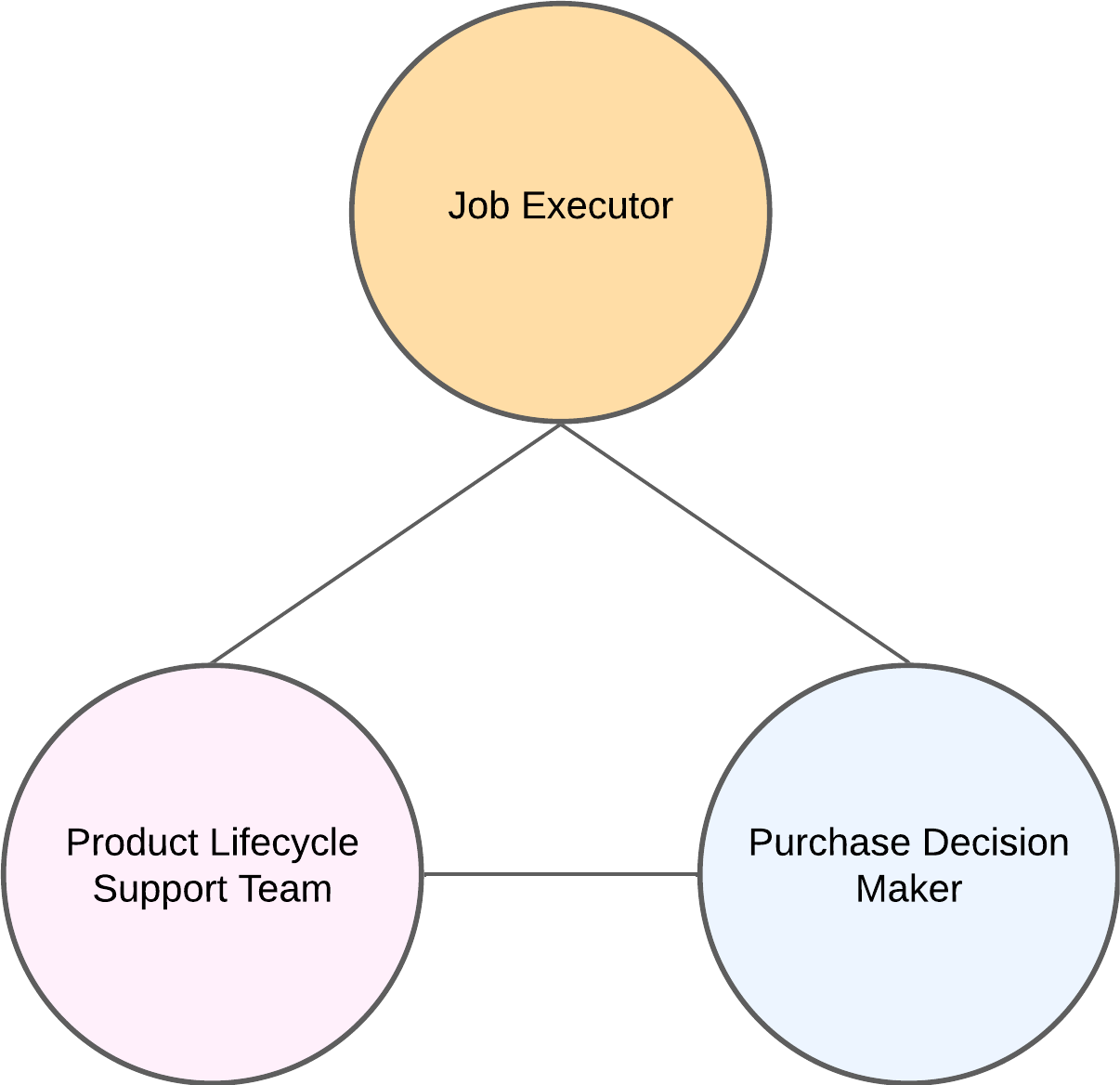
The Job Executor is the person or role that performs the core functional job, the fundamental reason why your market exists. This person directly uses your product or service to accomplish their goal.
Consider the healthcare technology market: A hospital administrator might make purchasing decisions, and IT staff might handle installation and maintenance, but if you're developing surgical instruments, your primary job executor is the surgeon. Their needs, constraints, and desired outcomes should drive your core product efforts.
Product Lifecycle Support Teams play a different role. These individuals handle the consumption chain jobs, which are all the tasks associated with the product's lifecycle, encompassing everything from installation and maintenance to storage and disposal. They impact the overall customer experience but don't execute the core job. In a manufacturing setting, while machine operators are the job executors for production equipment, maintenance technicians form the support team, handling tasks like equipment calibration and repairs.
The Purchase Decision Maker (or buyer) holds the purse strings but may have limited interaction with the product itself. In B2B contexts, this role often belongs to procurement teams or senior management. While their needs must be addressed in your go-to-market strategy and business model, their requirements shouldn't drive core product innovation.
Author's Note: Be careful here. In B2B software, it is tempting to build features exclusively for the Purchase Decision Maker (e.g., fancy admin dashboards or compliance reports) because that is what "closes the deal." However, if you neglect the Job Executor, you end up creating "Shelfware"—software that is bought but never used. Long-term retention only comes from satisfying the Job Executor.
While identifying these roles might seem straightforward, modern business models often present more complex scenarios. In platform businesses, there may be multiple distinct job executors, each with their own core jobs to be done. For instance, a marketplace platform needs to simultaneously serve and understand two different types of job executors: suppliers and consumers, each with distinct needs and success metrics.
The key lies in properly identifying and prioritizing these roles during your research and development process.
Who to prioritize?
While identifying job executors and purchase decision makers is necessary, determining which group to target primarily for your go-to-market strategy presents a challenge for many teams.
Platform businesses face what's known as the "chicken and egg problem": the need to build both sides of a marketplace simultaneously to create value. However, successful platforms typically solve this by identifying which side is more crucial for building initial marketplace liquidity.
Important Note for JTBD: When dealing with a platform like Uber or Airbnb, you are not researching "one market." You are researching two distinct markets that happen to interact.
- Market A: Drivers (Executor) + Earn Income (Job)
- Market B: Passengers (Executor) + Get to Destination (Job)
You must make a strategic choice on which market to prioritize first. Andrew Chen describes this as the hard side of the network in his book "The Cold Start Problem" (2021)[25]. Chen observes that there is typically a minority of users who create disproportionate value but are harder to acquire and retain.
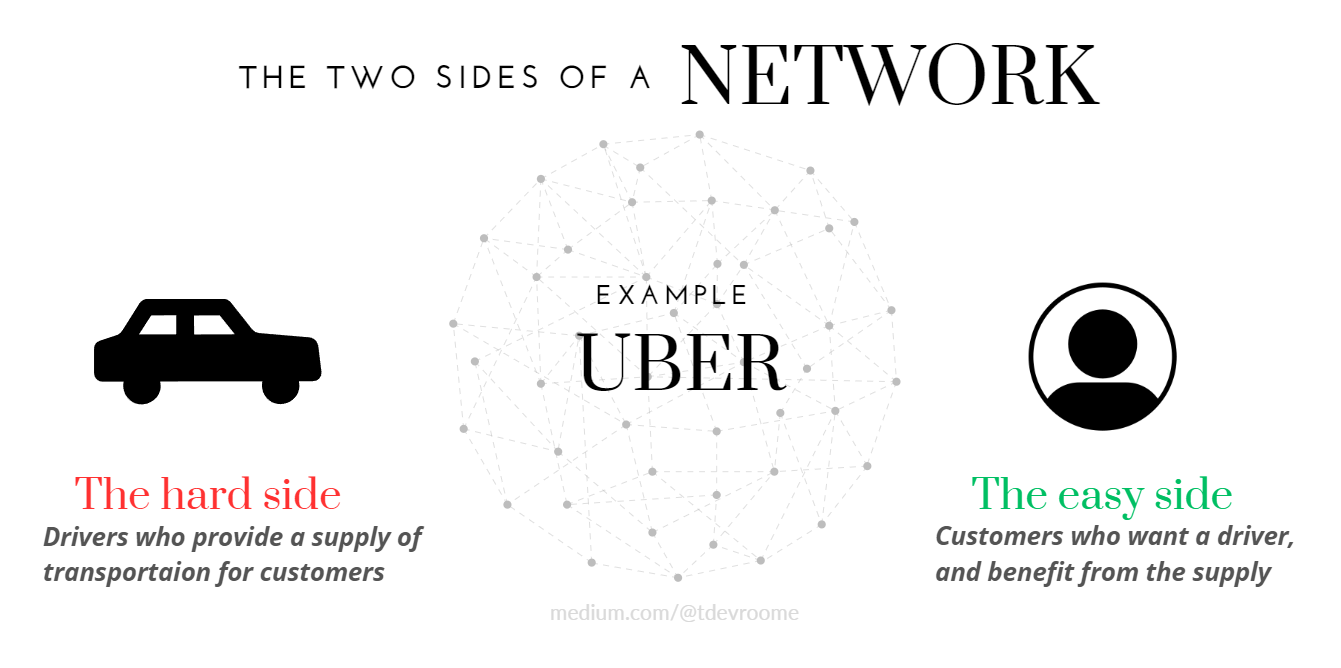
Consider Wikipedia's business model. While hundreds of millions use the platform, only a tiny fraction actively contribute content, yet these contributors create the core value that attracts all users. Similarly, for platforms like Steam (the gaming marketplace), individual game developers create content that might be downloaded millions of times.
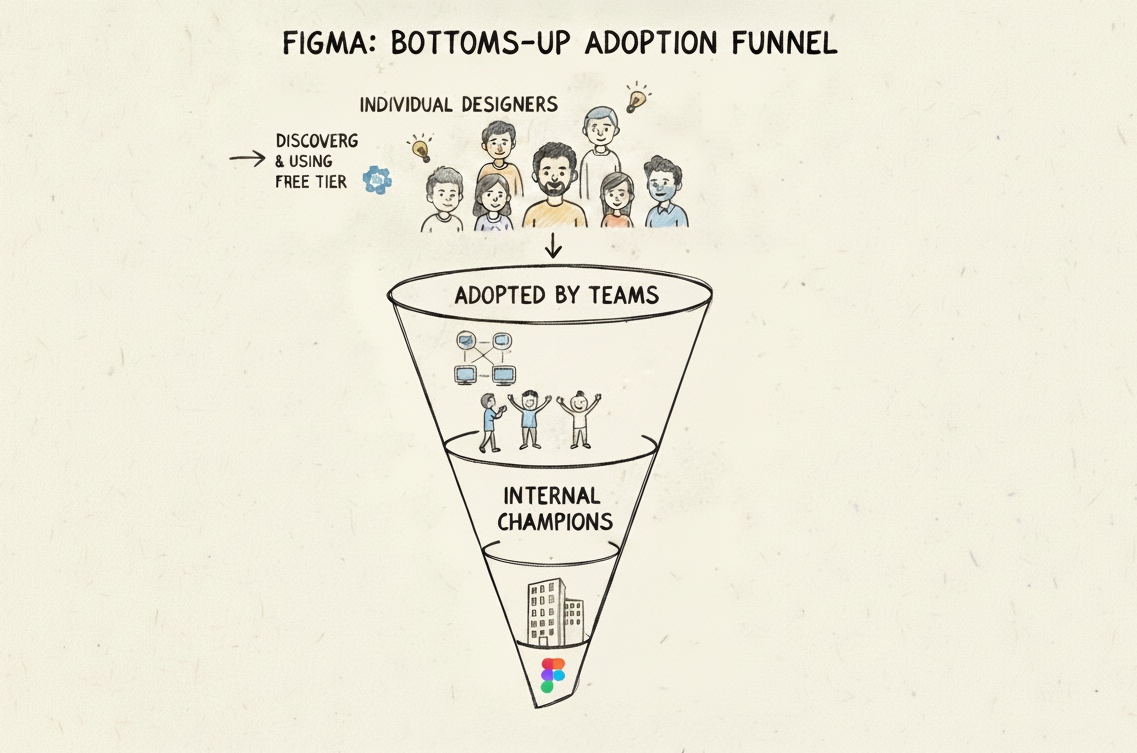
For non-platform products, the targeting decision typically revolves around three key factors: pain point intensity, purchase decision influence, and accessibility. Modern SaaS tools like Figma illustrate this well. While both individual designers and IT teams are important stakeholders, Figma targeted individual designers first because they had the strongest pain point, could influence purchase decisions through bottom-up adoption, and were easily accessible through design communities.
For the majority of businesses, my recommendation is to focus initial targeting efforts on those who use your product most frequently, so typically the job executor or end consumer. This approach recognizes that sustainable product adoption and growth usually stem from solving real problems for actual users rather than just appeasing purchase decision makers.
Questions to help identify the job executor, Product Support Team, and Purchase Decision Maker
Identifying the Job Executor
The most reliable way to identify your true job executor is to ask targeted questions that reveal who actually performs the core functional job. Key questions include:
- Who physically interacts with and operates the product/service on a daily basis?
- Whose success metrics are directly tied to the product's core functionality?
- If the product stopped working, who would be immediately impacted in their ability to complete their work?
- In a typical workday, who spends the most time directly using the product?
Mapping the Product Lifecycle Support Team
Support teams can be identified by examining who handles the peripheral but essential tasks surrounding your product. Consider:
- Who handles product setup, configuration, and maintenance?
- When something goes wrong, who gets called first?
- Who manages user access, permissions, and system administration?
Understanding Purchase Decision Makers
To identify purchase decision makers, focus on financial authority and accountability:
- Who owns the budget that pays for this solution?
- Who evaluates competing solutions and creates vendor shortlists?
- Who is accountable for ROI on this purchase?
Common Pitfalls in Role Identification
Teams frequently encounter several challenges when identifying these roles:
- Overemphasizing organizational authority instead of actual job execution.
- Mistaking frequent product interaction for job execution.
- Assuming job executors are always lower-level employees.
- Missing secondary job executors in platform businesses.
By working through these questions and conducting careful observation, teams can build a clear picture of their key stakeholders and ensure their product development efforts are properly targeted.
Next Step: Uncovering the core job/need
At this point, you've mapped the stakeholder landscape for your market. You know the difference between the job executor (the person actually doing the work), the product lifecycle support team (the people who install, maintain, and troubleshoot), and the purchase decision maker (the person who controls the budget). You understand that in platform businesses, you're dealing with two distinct markets, each with its own executor and its own job.
You've also learned who to prioritize: for core product innovation, the job executor almost always takes precedence. Building for buyers instead of users creates shelfware. Building for the hard side of a network creates the foundation for marketplace liquidity. But knowing who to focus on is only half the equation. The next question is: what are they actually trying to accomplish?
This is where the core functional job comes in. The job executor you've identified doesn't just "use your product." They're trying to achieve something specific, something that exists independent of your solution. A surgeon using surgical instruments isn't just "operating equipment." They're trying to perform precise surgical procedures with minimal patient trauma. A marketing project manager using Asana isn't just "managing tasks." They might be trying to align stakeholders on project progress or translate project goals into an actionable plan. Defining this core functional job with precision is the foundation for everything that follows in your JTBD research. If you get this wrong, the rest of your research will be flawed.
In the next chapter, we'll explore how to articulate the core functional job clearly, how to navigate the hierarchy of abstraction (knowing when to zoom in and when to zoom out), and how to handle the common challenge of products that serve multiple jobs for different users. The stakeholder identification work you've done here ensures you're defining the right job for the right person.
Chapter 3 Key Takeaways
- The Market Formula: In ODI, a market is defined as
Market = [Job Executor] + [The Job-to-be-Done]. - Define your market by the job, not the product: This reveals the true competitive landscape (e.g., Netflix competes with sleep).
- Distinguish the roles: Clearly separate the Job Executor (user), the Product Lifecycle Support Team (installer/maintainer), and the Purchase Decision Maker (buyer).
- Beware the Buyer Trap: For core product innovation, always prioritize the needs of the Job Executor to avoid building "shelfware."
- Two-Sided Markets: In platform businesses, treat the supply side and demand side as two distinct markets with two different jobs.
Chapter 3: Practice Questions
These exercises are designed to help you apply the core concepts of defining a market through a Jobs-to-be-Done lens.
Exercise 1: Redefining the Market
Instructions: For each product listed below, first articulate the traditional, product-defined market. Then, redefine the market by identifying a higher-level core functional job.
- Product: A high-end espresso machine for home use.
- Product: A financial budgeting app (like Mint or YNAB).
- Product: A project management software (like Asana or Trello).
Exercise 2: Identifying Key Stakeholder Roles
Instructions: For each scenario, identify the Job Executor, Product Lifecycle Support Team, and Purchase Decision Maker.
- Scenario: A large law firm is purchasing a new document management system. Paralegals use it daily. IT installs it. Managing partners sign the check.
- Scenario: A family buys a smart home security system. Parents monitor it. One parent installs it. Both parents pay for it. The teenager uses it to enter the house.
- Scenario: A freelance marketplace connects writers with businesses.
Exercise 3: Strategic Prioritization
Scenario: You are launching a new platform "SkillSwap" connecting learners with experts. Based on the "hard side of the network" concept, which group should you prioritize in your initial go-to-market strategy: the learners or the experts? Why?
References
[22] Moonshots. (n.d.). Travis Kalanick–Episode 2. Retrieved from https://www.moonshots.io/episode-02-travis-kalanick
[23] TechGoondu. (2015, September 17). Uber: We want transportation to be as reliable as running water. Retrieved from https://www.techgoondu.com/2015/09/17/uber-we-want-transportation-be-as-reliable-as-running-water/
[24] Medium. (2014, July 16). Airbnb announces complete rebranding with a “symbol of belonging”. Retrieved From https://medium.com/@bchesky/belong-anywhere-ccf42702d010
[25] Chen, A. (2021). The Cold Start Problem: How to Start and Scale Network Effects. Harper Business. Retrieved From https://www.amazon.com/Cold-Start-Problem-Andrew-Chen/dp/0062969749
[25] de Vroome, T. (2023). Book Summary: The Cold Start Problem. Medium. Retrieved From https://tdevroome.medium.com/book-summary-the-cold-start-problem-2306afb9bc9d