Chapter 2: The Outcome Driven Innovation Approach Introduction
Putting Jobs-to-be-Done theory to practice
Outcome Driven Innovation (ODI) is a structured framework that helps put Jobs-to-be-Done theory into practice.
Developed by Tony Ulwick and applied across numerous industries through his firm Strategyn, ODI focuses on identifying gaps between what customers want to accomplish and how well current solutions serve those needs. Strategyn claims high success rates for their approach, around 86% according to their internal studies [21].
Author's Note: It is worth noting the 86% success rate comes from Strategyn's internal research. I am generally skeptical of such "success rates" and how exactly this percentage was determined. It likely is just a catchy metric to help promote the methodology.
Notably, ODI addresses only a few parts of innovating
- identifying unmet customer needs
- Quantifying the unmet needs found
- Understanding the context around the needs (emotional and social jobs)
- Segmentation based on needs
Success still depends on a company's ability to design, develop, and market solutions that address those needs effectively. What ODI does provide is a way to help teams turn the abstract theory of JTBD into tangible, practical steps.
Set realistic expectations. ODI is not a silver bullet. This framework provides a lens for understanding customer problems, their journeys, and what they're ultimately trying to achieve, but it won't answer every strategic question or guarantee product success. It is simply one tool in one's toolkit.
Anyone claiming that any single methodology solves all innovation challenges is likely either trying to sell you something or lacks sufficient real-world experience with the complexities of product development.
I am prioritizing and anchoring this book to the Strategyn approach to implementing JTBD because I have found it provides the most "linear" and step-by-step documentation. While other approaches—like Bob Moesta’s "Jobs-as-Progress"—are excellent for understanding the emotional "why" behind a purchase, ODI provides the engineering-grade "how" that product teams often require to build the solution.
The 5 step ODI approach
ODI follows a systematic five-phase approach that moves from understanding customer jobs to implementing winning strategies. Each phase builds on the previous one.
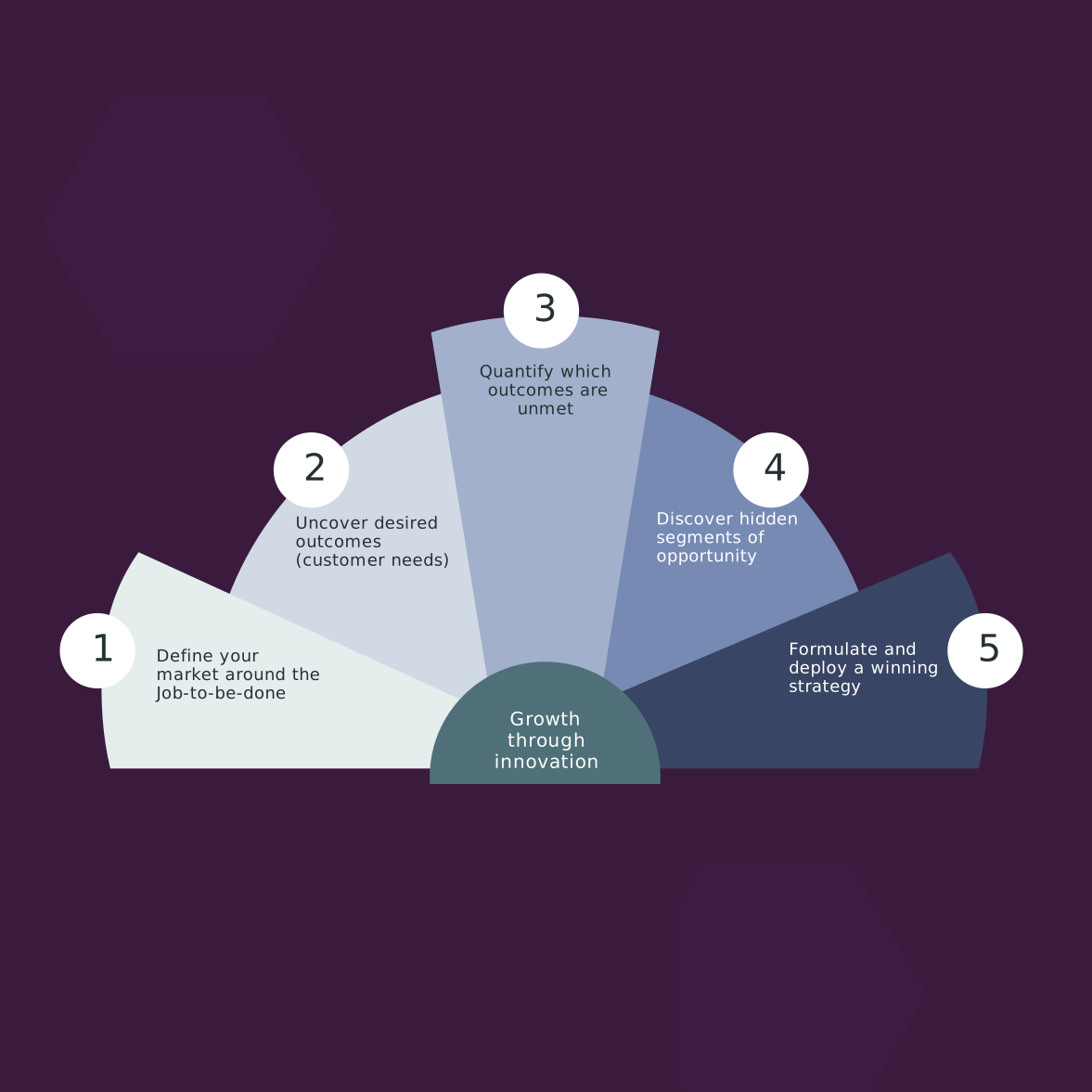
Phase 1: Define the Market Around the Job-to-be-Done
This step involves identifying the core functional job customers are trying to accomplish, along with related emotional and social jobs. In ODI, a market is defined specifically as The Job Executor + The Job-to-be-Done.
For example, when people "plan a vacation," the functional job might be "organize travel arrangements," but there are also emotional jobs like "create anticipation for a enjoyable experience" and social jobs like "demonstrate thoughtfulness to travel companions."
This phase also maps the complete ecosystem around the job, including job executors (who actually performs the job), supporting cast members (who help or are affected by the job), and purchase decision makers (who choose and buy solutions). In B2B contexts, these roles are often split across different people and departments, making this mapping essential for understanding the complete value proposition.
Rather than defining markets by product categories or customer demographics, ODI defines them by the fundamental progress customers seek to make. This perspective often shows that your competition isn't who you think it is, and your biggest opportunities is outside outside your usual market.
Phase 2: Uncover the customer’s needs
Through qualitative interviews and secondary research, teams uncover the specific outcomes customers use to evaluate success when getting their job done.
For instance, when helping customers "plan a vacation," some outcomes might include: minimize the time it takes to compare accommodation options, minimize the likelihood of booking hotels that don't match expectations, maximize confidence that the itinerary will be enjoyable for all travelers, and minimize the cost of changing plans if circumstances change.
This phase typically reveals 100+ outcome statements that capture the full spectrum of customer needs (functional, emotional, and social). These outcomes are carefully crafted to be stable over time (they don't change with technology), solution-agnostic (they don't assume any particular way of solving the problem), and measurable in ways that customers can evaluate.
Author's Note: Yes, it says 100+ outcome or need statements. If that sounds overwhelming, you are not alone. I will discuss in later chapters why this approach to quantification does not make sense for 99% of teams and how to manage it without getting bogged down. Chapter 7 highlights these concerns in more detail.
Phase 3: Quantify Unmet Needs
Qualitative interviews tell you what the needs are; Phase 3 tells you which ones matter. Through surveys, teams measure how Important each outcome is to customers and how Satisfied they are with current solutions.
ODI uses a specific opportunity scoring algorithm to process this data:
This formula heavily weights features that are important but currently frustrating. This generates a quantitative score for every single need.
- Underserved Needs: High Importance, Low Satisfaction. These are your opportunities for innovation.
- Overserved Needs: Low Importance, High Satisfaction. These are opportunities for disruption (simpler, cheaper solutions).
The result is typically visualized as a scatter plot, often called the Opportunity Landscape, which instantly shows you where the market is broken.
Phase 4: Discover hidden segments of opportunity
This phase identifies groups of customers with similar sets of unmet needs, creating needs-based segments that often reveal opportunities competitors miss entirely. Unlike traditional demographic segmentation, these segments are based on what customers are trying to achieve rather than who they are.
For example, instead of segmenting business travelers by company size or industry, you might discover segments like "efficiency optimizers" (who prioritize minimizing travel time and maximizing productivity) and "experience seekers" (who value comfort and amenities even for business trips). These segments cut across traditional demographic boundaries but represent distinct opportunity spaces for innovation.
Phase 5: Formulate and deploy a winning strategy
Once you have needs-based segments and a quantified market map, the path forward becomes a calculation rather than a guess. Strategyn's framework categorizes the opportunities into specific strategic avenues based on the data:
- Dominant Strategy: If you can satisfy underserved needs better and cheaper, you target the whole market.
- Differentiated Strategy: If a specific segment is underserved, you build a premium solution for them (charging more for better performance).
- Disruptive Strategy: If the market is overserved (too much performance), you build a simpler, cheaper solution to capture the low end.
The goal of Phase 5 is to align your product roadmap, marketing messaging, and pricing to the specific opportunity landscape of your target segment.
Author's Note: I disagree with the framing that a methodology alone can "formulate" a strategy. A spreadsheet can give you coordinates, but it cannot drive the ship. In my experience, ODI provides inputs (sometimes confusing ones!) for strategy, but it must be paired with business context, technical feasibility, and competitive reality. We will explore how to blend these insights in Chapter 11.
Reconciling the Tension
This distinction deserves a moment of clarification before we move on. The disagreement is not with the value of Phase 5, but with its naming convention. Calling this phase "formulate a strategy" implies that the methodology delivers a complete strategic plan. It does not.
What ODI actually delivers at this stage is an input to strategy: a recommendation about where market opportunities exist and which customer segments are most underserved. It provides a rationale for prioritization. It helps teams avoid building features nobody wants.
However, real strategy requires additional layers. You must consider what your organization can build (technical feasibility), what fits your business model (financial viability), and how competitors might respond (market dynamics). ODI is one way to tell you where the opportunity is. It does not tell you whether pursuing that opportunity makes sense for your specific company at this specific moment.
For now, understand that Phase 5 provides a clear direction. In later chapters, particularly Chapter 10 on the Growth Strategy Matrix and Chapter 11 on translating strategy into execution, we will examine how to combine this signal with the other inputs that true strategy requires.
Chapter 2 Key Takeaways
The ODI process follows five key steps:
- Define the market around the job-to-be-done: Specifically, define the market as "The Executor + The Job."
- Uncover desired outcomes: Gather the metrics customers use to measure success (typically 100+ outcomes).
- Quantify unmet outcomes: Use the Opportunity Score formula to identify underserved needs.
- Discover hidden opportunity segments: Group customers by their needs, not their demographics.
- Formulate and deploy strategy: Build features that target the high-opportunity scores.
ODI differs from traditional approaches by:
- Looking beyond existing solutions.
- Segmenting by needs rather than demographics.
- Understanding problems before jumping to solutions.
- Using structured metrics instead of vague customer feedback.
A Final Note on Expectations
As we proceed through this book, keep the Phase 5 tension in mind. ODI is a powerful lens for understanding customer needs, but it is one input among many. The chapters ahead will teach you how to execute each phase rigorously. They will also teach you where the methodology has limitations and how to compensate for them. The goal is not to follow a process blindly, but to develop judgment about when and how to apply these tools effectively.
References
[21] Strategyn. (2019). Innovation Track Record Study. Retrieved from https://strategyn.com/wp-content/uploads/2019/10/Innovation-Track-Record-Study-Strategyn-1.pdf